
Lucas-Folge
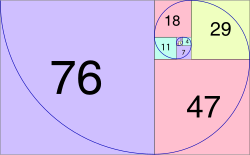
Unter der Lucas-Folge versteht man zwei unterschiedliche Dinge:
- Einerseits die Folge der Lucas-Zahlen
- bei der jedes Folgenglied (ab dem dritten) die Summe der beiden vorhergehenden ist.
- Andererseits die beiden allgemeinen Lucas-Folgen
 und
und
 , die abhängig von den
Parametern
, die abhängig von den
Parametern
 und
und
 als diejenigen Folgen definiert sind, die
 bzw.
bzw.

- erfüllen und den Rekursionsformeln
 bzw.
bzw.

- für
 genügen.
Die Lucas-Folgen sind nach dem französischen Mathematiker Édouard Lucas benannt, der sich als erster mit ihnen beschäftigt hat.
Beispiele
- Sei
 und
und
 . Dann ist
 die folgende Folge:
- Kurz geschrieben erhält man die Fibonacci-Folge:





- Sei und
. Dann ist
 die folgende Folge:
- Kurz geschrieben erhält man eine Folge, die man ebenfalls kurz spezielle Lucas-Folge (oder noch einfacher nur Lucas-Folge) nennt, nämlich:
- Die einzelnen Zahlen dieser Folge nennt man Lucas-Zahlen, auf die weiter unten näher eingegangen wird.





- In einer Tabelle zusammengefasst erhält man für gewisse Startwerte für
und
die Tabelle im Abschnitt Spezialfälle.
Explizite Formeln
Vorbereitung
Zur Bestimmung der Folgenglieder der allgemeinen Lucas-Folge muss vorbereitend die zugeordnete quadratische Gleichung gelöst werden.
Für die expliziten Formeln werden die beiden Lösungen
 und
und
 der quadratischen Gleichung
 benötigt. Es sind dies

und

Ist 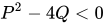 , so ist eine der beiden
komplexen Wurzeln zu wählen. Welche der beiden Zahlen
und welche
genannt wird, ist hierbei nicht von Belang.
, so ist eine der beiden
komplexen Wurzeln zu wählen. Welche der beiden Zahlen
und welche
genannt wird, ist hierbei nicht von Belang.
Die Parameter und
und die Werte
und
sind voneinander abhängig, es gilt umgekehrt
 (
(Die Formeln für und
lassen sich in Bezug auf die Potenzen verallgemeinern. Und zwar gilt:
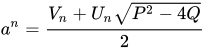
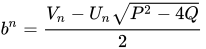
Die allgemeinen Lucas-Folgen
Falls 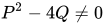 gilt, oder äquivalent dazu: falls die Zahlen
> und
verschieden sind, so berechnet sich das Glied der allgemeinen Lucas-Folge
gilt, oder äquivalent dazu: falls die Zahlen
> und
verschieden sind, so berechnet sich das Glied der allgemeinen Lucas-Folge
 nach folgender Formel:
für alle  . Im Spezialfall
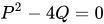 gilt stattdessen

Das Glied der allgemeinen Lucas-Folge  berechnet sich nach folgender Formel:
für alle
Beziehungen zwischen den Folgegliedern
Eine Auswahl der Beziehungen zwischen den Folgengliedern ist:[1]



 ,
falls
,
falls 
 ;
für alle
;
für alle 
Spezialfälle
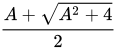
Es folgen ein paar Spezialfälle, die zu Folgen führen, die in der Mathematik eine wichtige Rolle spielen und deswegen sogar eigene Namen haben:
|
|
|
|
 |
 |
|---|---|---|---|---|---|
 |
 |
 |
 |

(Folge A000045 in OEIS) (Fibonacci-Folge) |

(Folge A000032 in OEIS) ((spezielle) Lucas-Folge) |
|
 |
 |
|

(Folge A001045 in OEIS) (Jacobsthal-Folge) |

(Folge A014551 in OEIS) (Jacobsthal-Lucas-Folge) |
|
|
 |
 |

(Folge A000129 in OEIS) (Pell-Folge) |

(Folge A002203 in OEIS) (Companion Pell-Folge, Pell-Lucas-Folge) |
 |
|
|
|

(Folge A000225 in OEIS) (Mersenne-Zahl-Folge) |

(Folge A000051 in OEIS) (Zahlen der Form  (enthalten die Fermat-Zahlen))
 |
 |
|
 |
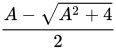 |
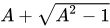
Fibonacci-Polynome | Lucas-Polynome |
 |
|
 |
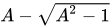 |
Tschebyschow-Polynome zweiter Art | Tschebyschow-Polynome erster Art, mit
multipliziert |
 |
|
|
|
 mit mit

Repunits zur Basis A |
 -Folge -Folge |
Es gibt aber auch viele weitere Spezialfälle, die zu Folgen führen, die einen OEIS-Eintrag haben und somit in der Mathematik ebenfalls eine gewisse Rolle spielen. Es folgen ein paar Beispiele:
|
|
|
|
|
|
|---|---|---|---|---|---|
| |
|
 > >
(Folge A128834 in OEIS) |

(Folge A087204 in OEIS) | ||
|
|

(Folge A107920 in OEIS) |

(Folge A002249 in OEIS) | ||
|
|
|
|

(Folge A001477 in OEIS) |

(Folge A007395 in OEIS) |
|
|

(Folge A009545 in OEIS) |

(Folge A009545 in OEIS) | ||
|
|

(Folge A088137 in OEIS) |
 | ||
|
 |

(Folge A088138 in OEIS) |
 | ||
|
 |

(Folge A045873 in OEIS) |
 | ||
|
 |
|
|

(Folge A015528 in OEIS) |
 |
|
 |

(Folge A015523 in OEIS) |

(Folge A072263 in OEIS) | ||
|
 |
|
|

(Folge A015521 in OEIS) |

(Folge A201455 in OEIS) |
|
 |

(Folge A030195 in OEIS) |

(Folge A172012 in OEIS) | ||
|
|

(Folge A007482 in OEIS) |

(Folge A206776 in OEIS) | ||
|
|

(Folge A006190 in OEIS) |

(Folge A006497 in OEIS) | ||
|
|

(Folge A001906 in OEIS) |

(Folge A005248 in OEIS) | ||
|
|

(Folge A0190959 in OEIS) |
 | ||
|
|
|
|

(Folge A015531 in OEIS) |

(Folge A087404 in OEIS) |
|
|

(Folge A015530 in OEIS) |

(Folge A080042 in OEIS) | ||
|
|

(Folge A090017 in OEIS) |
 | ||
|
|

(Folge A001076 in OEIS) |

(Folge A014448 in OEIS) | ||
|
|

(Folge A001353 in OEIS) |

(Folge A003500 in OEIS) | ||
| > |
|

(Folge A007070 in OEIS) |

(Folge A056236 in OEIS) | ||
|
|
|
|

(Folge A003462 in OEIS) |

(Folge A034472 in OEIS) |
|
|
|
|

(Folge A001787 in OEIS) |

(Folge A000079 in OEIS) |
|
 |
 |
|

(Folge A015540 in OEIS) |

(Folge A0274074 in OEIS) |
|
|

(Folge A015536 in OEIS) |
 | ||
|
|

(Folge A015535 in OEIS) |
 | ||
|
|

(Folge A052918 in OEIS) |

(Folge A087130 in OEIS) | ||
|
|

(Folge A004254 in OEIS) |

(Folge A003501 in OEIS) | ||
|
|
|
|

(Folge A002450 in OEIS) |

(Folge A052539 in OEIS) |
 |
 |
 |
|

(Folge A015577 in OEIS) |
 |
Die allgemeinen Lucas-Folgen U(P,Q), V(P,Q) und die Primzahlen
Die allgemeinen Lucas-Folgen  und
und
 haben für ganzzahlige Parameter
und
eine spezielle Eigenschaft hinsichtlich der Teilbarkeit durch
Primzahlen. Diese Eigenschaft wurde für Verfahren zur Bestimmung der Primalität einer Zahl angewandt (siehe auch Lucas-Lehmer-Test).[2]
haben für ganzzahlige Parameter
und
eine spezielle Eigenschaft hinsichtlich der Teilbarkeit durch
Primzahlen. Diese Eigenschaft wurde für Verfahren zur Bestimmung der Primalität einer Zahl angewandt (siehe auch Lucas-Lehmer-Test).[2]
Die Folgen U(P,Q)
Für alle Lucas-Folgen 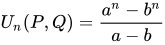 gilt:
gilt:
- Ist p eine Primzahl, so ist
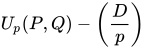 durch p teilbar.
Dabei ist  das
Legendre-Symbol.
das
Legendre-Symbol.
Es existieren auch zusammengesetzte Zahlen, die diese Bedingung erfüllen. Diese Zahlen nennt man Lucas-Pseudoprimzahlen.
Die Folgen V(P,Q)
Für alle Lucas-Folgen  gilt:
gilt:
- Ist p eine Primzahl, so ist
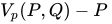 durch
durch
 teilbar.
Eine zusammengesetzte Zahl, die diese Bedingung (im Fall von
 und
und
 ) erfüllt, heißt Fibonacci-Pseudoprimzahl.
Besonders interessant ist die Teilbarkeitsbedingung für die Folge
 . Für diese Folge gilt nämlich:
- Wenn
 eine Primzahl ist, dann gilt:
teilt
eine Primzahl ist, dann gilt:
teilt
 .
.
Dies ist eine spezielle Form des kleinen Fermatschen Satz.
Analog zu  gilt hier
 .
.
Die spezielle Lucas-Folge
Die allgemein als Lucas-Folge bekannte Folge
 der Lucas-Zahlen 2, 1, 3, 4, 7, 11, 18,
29, … lässt sich außer durch die Rekursion
der Lucas-Zahlen 2, 1, 3, 4, 7, 11, 18,
29, … lässt sich außer durch die Rekursion
 mit den Anfangswerten
 und
und
 auch wie folgt erzeugen:
- Wie im allgemeinen Fall für die Folgen
 erwähnt, über die Formel von Binet
(nach Jacques Philippe Marie Binet):
erwähnt, über die Formel von Binet
(nach Jacques Philippe Marie Binet):
 , da
, da
 und
und
 gilt.
a ist übrigens die goldene Zahl
gilt.
a ist übrigens die goldene Zahl
 .
.
- Eine andere rekursive Formel (mit Gaußklammer):
- Als Summe zweier Glieder der Fibonacci-Folge:
 .
.
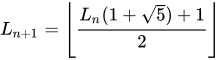
Nach 1) lässt sich alternativ auch  schreiben.
Da für der Betrag von
schreiben.
Da für der Betrag von
 stets kleiner 0,5 ist, ergibt sich die Eigenschaft, dass die
-te
() Lucaszahl dem gerundeten Wert der Golden Zahl zur Potenz
entspricht:
stets kleiner 0,5 ist, ergibt sich die Eigenschaft, dass die
-te
() Lucaszahl dem gerundeten Wert der Golden Zahl zur Potenz
entspricht:
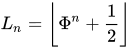 .
.
Reziproke Reihe
Der Grenzwert der absolut konvergierenden reziproken Reihe spezieller Lucas-Zahlen

ist irrational.[3]
Lucas-Primzahlen
Eine Lucas-Primzahl ist eine Lucas-Zahl, die prim ist. Die kleinsten Lucas-Primzahlen lauten:
- 2, 3, 7, 11, 29, 47, 199, 521, 2207, 3571, 9349, 3010349, 54018521, 370248451, 6643838879, 119218851371, 5600748293801, 688846502588399, 32361122672259149, 412670427844921037470771, … (Folge A005479 in OEIS)
Für diese Lucas-Primzahlen ist der Index von
der folgende:
- 0, 2, 4, 5, 7, 8, 11, 13, 16, 17, 19, 31,
37, 41, 47, 53, 61, 71, 79, 113, 313, 353, 503, 613, 617, 863, 1097,
1361, 4787, 4793, 5851, 7741, 8467, 10691, 12251, 13963, 14449, 19469,
35449, 36779, 44507, 51169, 56003, 81671, 89849, 94823, 140057, 148091,
159521, 183089, 193201, 202667, 344293, 387433, 443609, 532277, 574219,
616787, 631181, 637751, 651821, 692147, 901657, 1051849, … (Folge A001606 in OEIS)
- Beispiel:
- Es ist
 und
und
 . Somit ist
 eine Primzahl.
Tatsächlich taucht der Index
eine Primzahl.
Tatsächlich taucht der Index
 in obiger Liste an der 5. Stelle auf, weil er zur fünftkleinsten
Lucas-Primzahl
in obiger Liste an der 5. Stelle auf, weil er zur fünftkleinsten
Lucas-Primzahl  führt.
- Es ist
- Beispiel:
Es gelten folgende zwei Eigenschaften für Lucas-Primzahlen:
- Wenn eine Primzahl ist, dann ist der Index
entweder gleich
 oder eine selbst Primzahl oder eine
Zweierpotenz.[4]
oder eine selbst Primzahl oder eine
Zweierpotenz.[4]  ist eine Primzahl für
 . Für keine anderen bekannten Werte von
 erhält man weitere Primzahlen.
Es wird vermutet, dass es unendlich viele Lucas-Primzahlen gibt.[4]
Zusammenhang zur Artinschen Konstante
Die Artinsche Konstante, benannt nach Emil Artin, ist definiert durch

Dabei bezeichnet
 das Produktsymbol, wobei sich das Produkt über alle Primzahlen erstreckt. Die Konstante
 taucht in einer tiefen Vermutung von Artin über
die asymptotische Dichte von Primzahlen, die Primitivwurzeln zu einer gegebenen Zahl sind, auf.[5] Eine Primitivwurzel zu einer Primzahl
ist eine ganze Zahl, deren Potenzen, bis auf Vielfache von
, alle Zahlen zwischen
taucht in einer tiefen Vermutung von Artin über
die asymptotische Dichte von Primzahlen, die Primitivwurzeln zu einer gegebenen Zahl sind, auf.[5] Eine Primitivwurzel zu einer Primzahl
ist eine ganze Zahl, deren Potenzen, bis auf Vielfache von
, alle Zahlen zwischen
 erzeugen können. Zum Beispiel ist
eine Primitivwurzel bezüglich
erzeugen können. Zum Beispiel ist
eine Primitivwurzel bezüglich
 , denn die ersten echten Potenzen der
sind
, denn die ersten echten Potenzen der
sind
 und bis auf Vielfache von
entspricht dies den Zahlen
und bis auf Vielfache von
entspricht dies den Zahlen
 . Die Artinsche Vermutung besagt, grob gesprochen, dass zu festem
die Menge der Primzahlen, so dass
eine Primitivwurzel zu
ist, die asymptotische Dichte
innerhalb aller Primzahlen hat.
Also haben ca. 37 % der Primzahlen diese Eigenschaft, unabhängig von
>. Jedoch muss
dafür bestimmte Voraussetzungen erfüllen.
. Die Artinsche Vermutung besagt, grob gesprochen, dass zu festem
die Menge der Primzahlen, so dass
eine Primitivwurzel zu
ist, die asymptotische Dichte
innerhalb aller Primzahlen hat.
Also haben ca. 37 % der Primzahlen diese Eigenschaft, unabhängig von
>. Jedoch muss
dafür bestimmte Voraussetzungen erfüllen.
Bezeichnet die
-te Lucas-Zahl, so gilt die Formel

Dabei bedeutet  in der Summe, dass
 die Zahl
teilt,
und es ist
die Zahl
teilt,
und es ist  die Möbiusfunktion sowie
 die Riemannsche Zeta-Funktion.[6]
Siehe auch
Literatur
- Paulo Ribenboim: Die Welt der Primzahlen. Springer Verlag, 1996
Weblinks
- Eric W. Weisstein:
 Lucas Number. In: MathWorld (englisch).
 - Eric W. Weisstein: Lucas Sequence. In: MathWorld (englisch).
Einzelnachweise
- ↑ Siehe Ribenboim: Die Welt der Primzahlen, S. 44–70.
- ↑ Siehe das schon angegebene Kapitel im Buch von Ribenboim.
- ↑ Paulo Ribenboim: Meine Zahlen, meine Freunde: Glanzlichter der Zahlentheorie. Springer-Lehrbuch, 2009, ISBN 978-3-540-87955-8, S. 323.
- Hochspringen nach: 1 2 Chris K. Caldwell: Lucas prime. Prime Pages, abgerufen am 11. Juli 2026 (englisch).
- ↑ S. R. Finch: Mathematical Constants, Encyclopedia of Mathematics and its Applications 94, Cambridge University Press, 2003, S. 104.
- ↑ S. R. Finch: Mathematical Constants, Encyclopedia of Mathematics and its Applications 94, Cambridge University Press, 2003, S. 105.
 Wikipedia.de

© biancahoegel.de
Datum der letzten Änderung: Jena, den: 11.07. 2026